

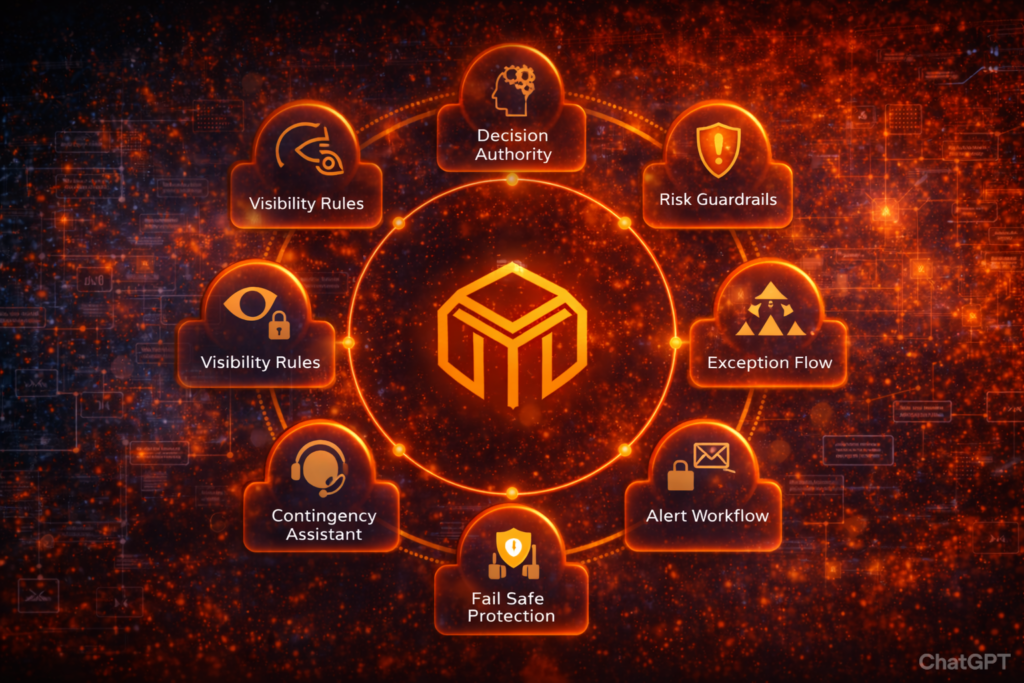
A structured decision system for designing stable, reliable automations within businesses.
Why the Framework Exists
The Triggeranode Framework was made to give businesses a repeatable method, keeping risk in mind, to think strategically, before automating.
It changes unclear, instinct-driven processes into documented, validated, and manageable systems that can be used for growth – safely.
What Problem It Solves
Most teams automate without understanding the logic behind systems and processes, so, tools end up running processes that were never fully understood.
This framework prevents that – forcing your business to:
• See the systems behind your business as a whole entity
• Verify the logic behind processes before you grow
• Prioritize automations by least risk, not convenience
• Design systems intentionally, not reactively
It replaces guesswork with structured decision-making.
What It Deliberately Avoids
The framework intentionally avoids:
• Tool tutorials
• Pre-built automations
• “Just do this” shortcuts
• Copy-and-paste templates
• Speed as a selling point
This protects your business from premature automation — the root cause of most failures.
This isn’t a template pack. It is a thinking system with guardrails.
How the Framework Is Used
Sequential Thinking
Each module builds on the previous one. You cannot skip steps.
The framework forces a disciplined progression from clarity → validation → design → execution → monitoring → scaling.
Forced Decision Points
Every module ends with a mandatory decision:
“Do we have enough operational stability to proceed?” If the answer is no, the framework halts your progress — by design. This prevents automating unstable processes that will lead to more errors and loss.
Documented Assumptions
Every decision, reliance, exception/error and risk is captured and documented. Documentation isn’t busywork — it becomes the control layer that protects the business when automation runs.
The result is not an automated process. The result becomes operational certainty.
Each module is a decision instrument. Below is the “core question – risk – required decision” format for all seven.
MODULE 1 — Operational Clarity
Core Question:
“What is actually happening inside our operation — not what we think is happening?”
Risk Addressed:
Automating imaginary or outdated processes that only exist in people’s heads.
Decision Required:
Have we fully mapped our real workflows and identified every dependency?
MODULE 2 — Validation Before Automation
Core Question:
“Is this workflow stable enough to handle automation?”
Risk Addressed:
Automating broken or fragile processes that collapse under pressure.
Decision Required:
Has the workflow passed manual validation, stability testing, and failure-point checks?
MODULE 3 — Automation Readiness Scoring
Core Question:
“Should this be automated now, later, or not at all?”
Risk Addressed:
Misplaced prioritisation: automating low-value work while high-risk bottlenecks remain untouched.
Decision Required:
What is the readiness score, and does the ROI justify proceeding?
MODULE 4 — System Design
Core Question:
“What is the simplest, most durable way this workflow can function?”
Risk Addressed:
Complexity bloat and hidden dependencies that make automation brittle or unreadable.
Decision Required:
Is the workflow architected in a way that can scale without new fragility?
MODULE 5 — Automation Execution (Tool-Agnostic)
Core Question:
“How should this be automated without locking the business into a specific tool?”
Risk Addressed:
Vendor lock-in, unmaintainable logic, and tool-based thinking that ignores operations.
Decision Required:
Is the automation logic, exception handling, and human safeguard design complete?
MODULE 6 — Monitoring & Stability
Core Question:
“How will we detect, understand, and respond to failures?”
Risk Addressed:
Silent errors, data drift, and invisible operational damage.
Decision Required:
Are monitoring rules, intervention triggers, and stability checks fully defined and implemented?
MODULE 7 — Scaling Without Chaos
Core Question:
“How do we expand operations without creating complexity that overwhelms the team?”
Risk Addressed:
Runaway scaling where automation expands faster than governance.
Decision Required:
Is the system safe to scale, and do we know the conditions under which we should not automate more?
Completing the framework does NOT mean you should automate. Completion means you have the clarity needed to make a safe, managed decision.
In many cases, the correct outcome is: “Delay automation until stability improves.”
Or even: “Do not automate this at all.”
The framework protects you from automating prematurely — and from automating unnecessarily.
Business Owners
Responsible for operational integrity and long-term risk.
Executives
Needing clear decision criteria before approving automation.
Senior Operators
Managing workflows, dependencies and day-to-day production processes.
The Triggeranode Framework is built for those accountable for results, not tools.
Understand your background business systems completely.
Reduce your risk of failure.
Automate with confidence.

Build Once. Validate. Automate. Let it Run
Copyright 2026, TRIGGERANODE. All Rights Reserved.